
I started off thinking this post was going to be about the fact that sunflowers make two different kinds of flowers, which I think is really interesting.
When we think of sunflowers, we think of the big showy flowers around a central disk. But the disk is made up of flowers, too!


And actually, the disk flowers are where the seeds are made.
And then, as I was looking at all my sunflower photos, I noticed something really interesting: the disk flowers are arranged in a spiral pattern. I’ve drawn lines to show the pattern. But once you get the hang of looking at the flowers, you can see the pattern without help. Try it looking at the sunflower without swirls, above.

Another sunflower, prairie coneflower, does the same thing.

The patterns develop according to the mathematical sequence of the Fibonacci sequence, after an Italian mathematician in the Renaissance, but the pattern was first noticed in India in the 2nd Century BC. It goes like this: 0, 1, 1, 2, 3, 5, 18, 23, 41 … The sequence results from the product of adding the two numbers before it. So 0 + 1 = 1, 1+1 = 2, 1+2=3, 2+3=5, 3+5=8 …
The Fibonacci sequence shows up in plants, animals, art, architecture, weather, computer science, and probably a few other places I haven’t heard about.
I think a mathematician could tell you why plants order their flowers this way. I think it has something to do with packing the most flowers into an expanding space.
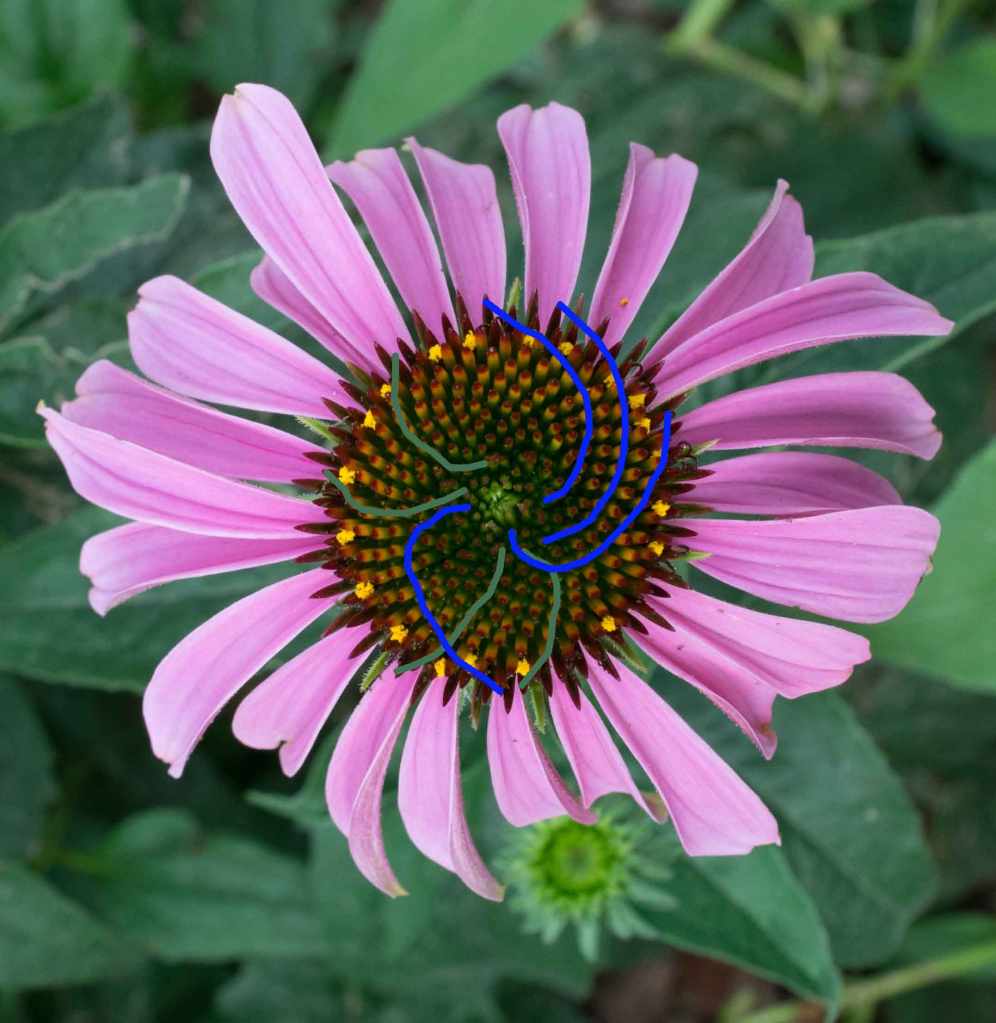
The way the math works out, the swirls go both ways, which I think is amazing!

And it’s not just sunflowers that do it — this teasel is in the honeysuckle family. I’ve written about other plants that I’ve seen the Fibonacci sequence in here.
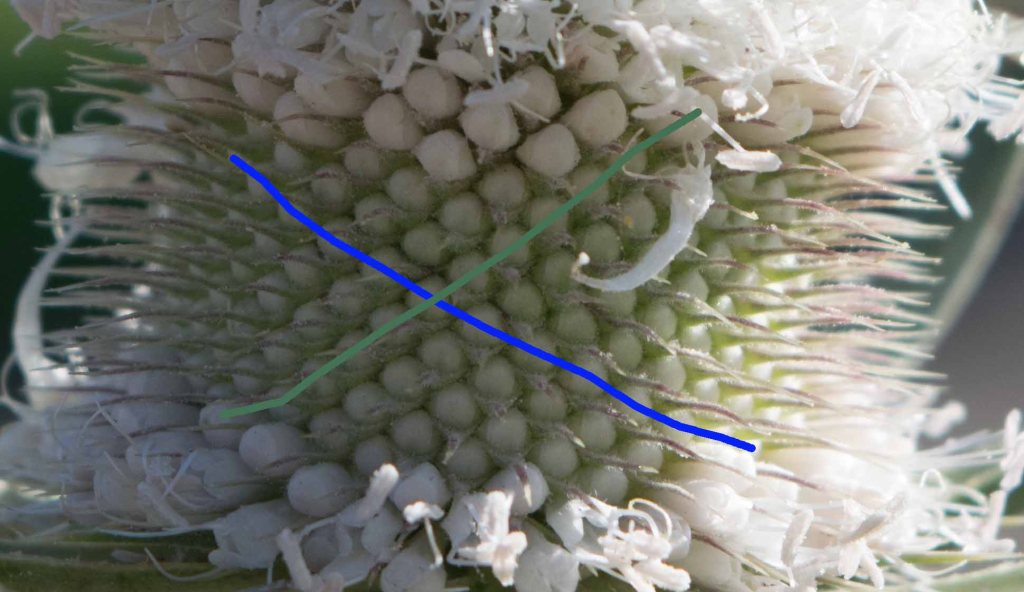
And then, I noticed that in addition to lining up with swirls that go both directions, the swirling patterns make a spiral out from the center.

I am constantly astonished by nature!


 Amy Law, Science Geek
Leave a comment