
2024 Pika Patrol

2024 Pika Patrol

If it’s fall, it must be time to look for pika!

As always, we are going out as part of the Colorado Pika Project, a Citizen Science project monitoring pika throughout the Colorado mountains.

Subalpine talus field that is home to pika.

This is the meadow (11,598 feet) where we start our search for pika. They live in the rocks directly in front of the camera, but even more so in the scree slope to the left behind the spruce trees.

Every year we’ve come up here, we actually hear the pika’s squeaky-ball calls before we even get out of the trees. It was no different this year — we had already heard them squeeking before I took this photo.

This is looking south up the slope to the scree where we usually find the pika. “Scree” is a jumble of loose rocks that have broken off the top of the mountain and end up in a loose pile wherever they end up when they stop sliding. Scree is slippery, unstable and jagged — we wear leather gloves (lower left corner) when we crawl over it.

After dropping our day packs by the big rock in the center right of the above photo, we start scrambling over the rocks in the middle of the photo, looking for little piles of grass and flowers that the pika cut and bring back to the rocks. They lay the leaves out to dry, turning the plants into hay. This is what the pika will live on through the winter.

We quickly found hay piles — lots of hay piles — tucked into spaces in between the rocks. We continued to hear them calling across the slope But we didn’t see any pika, which was unusual. Every other year, two or three pika have been scampering across the rocks a hundred feet or so away from us.

We were a little discouraged when we went back down to the big rock to have our lunch.

While we were sitting on the rocks, eating our peanut butter and jelly sandwiches, we heard another pika call from the scree slope directly behind us. We slowly turned around. And there, closer than any pika had ever come before, sat this little guy.
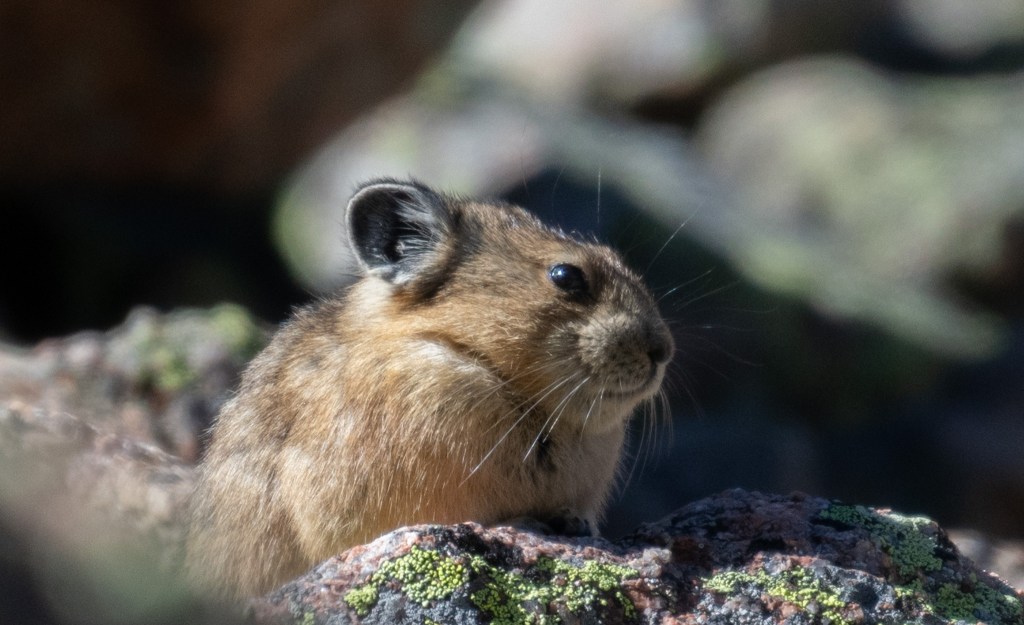
Close-up of a pika sitting on a neon-green lichen-covered pink granite rock.

Have you ever tried to slowly move very fast? That’s the way I felt as I reached for my camera.

But it didn’t matter. This pika had decided that we weren’t a threat, and it went about it’s business without another thought for us. It had hay to put up for the winter.

Pika sitting on a neon green lichen-covered pink granite rock.

I had never had a chance to see pika in depositing their plants in the alcoves before. But I got a shot of this one doing just that.

Pika hidden in the shadows of a cavity among the rocks. At the pika's feet are bits of plants it has left there to dry.

I’ve mentioned in previous posts that one of the big challenges of photographing these little critters is that they move. They dart and dash over and between and behind the rocks. For them to sit still is the exception, rather than the rule.

I love the shot below because it shows what acrobats pika are. This pika is banking off the rock as it sprints out of a crevice towards the plants it needs to harvest. I call it “pika parkour”.
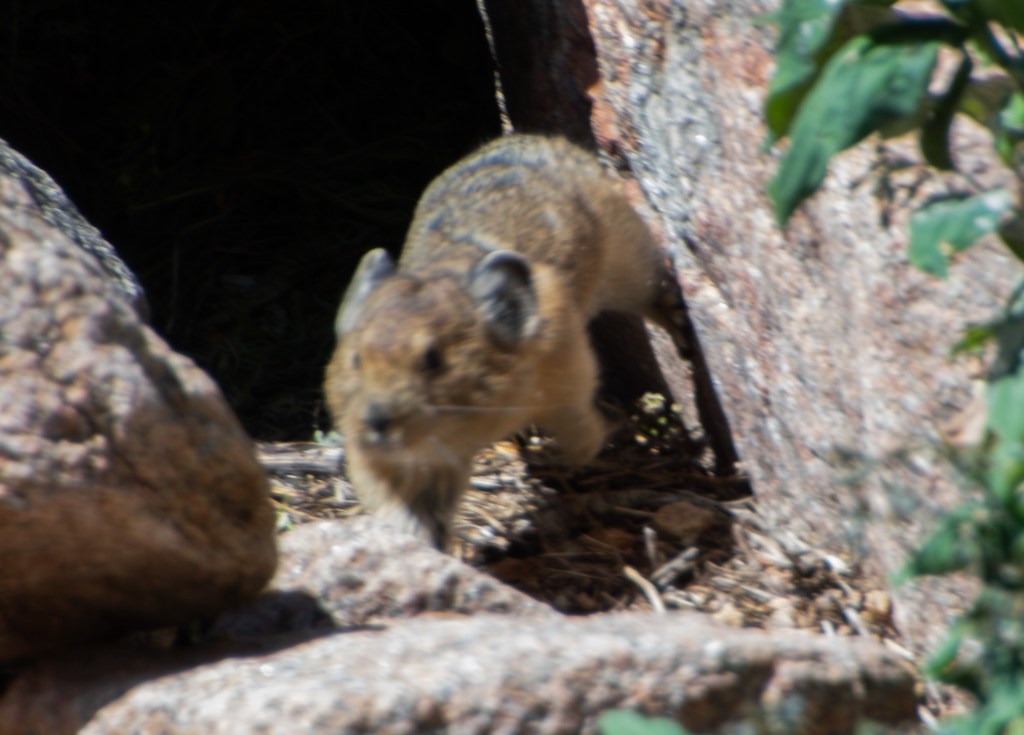
A three inch long pika sprints out from between some rocks. It's going so fast it has to bank off a rock in a parkour move.

For me, the holy grail of photographing pika is to catch them taking plants back to the drying areas. I’d gotten a few blurry shots before but nothing I was very satisfied with. This day, I found the grail.

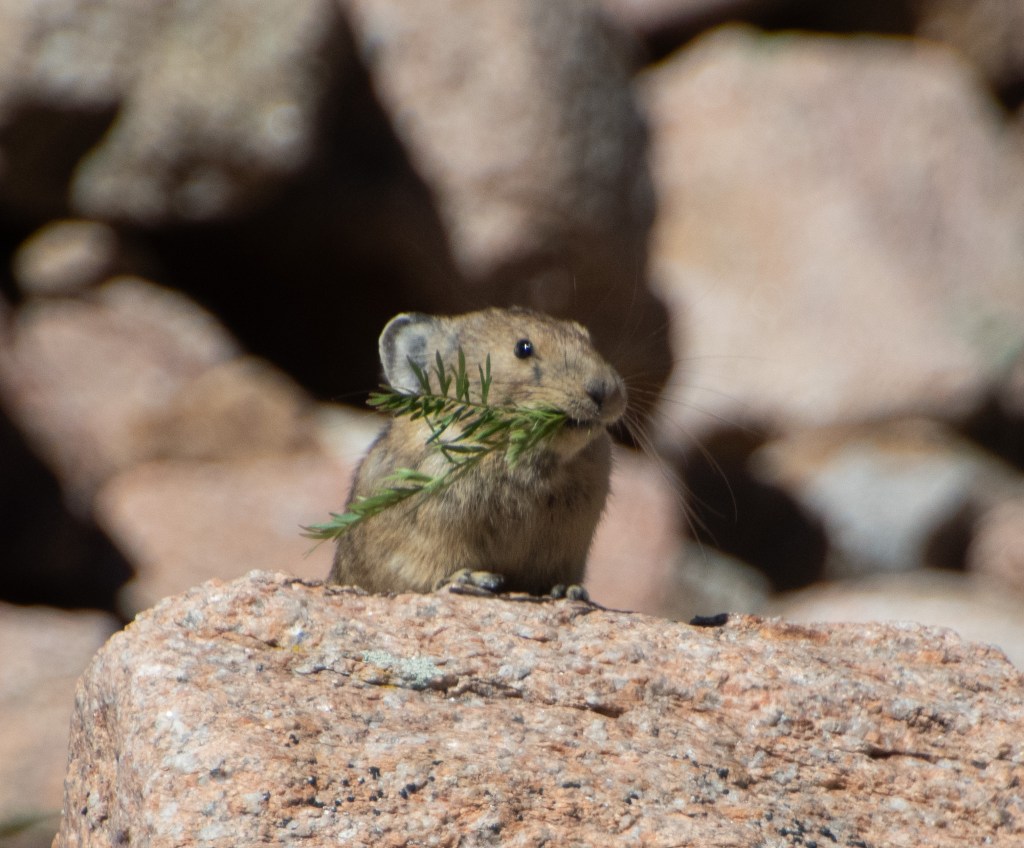
Pika with leaf in its mouth running over a pink granite rock.

Another good day with the pika. They seem to be doing well. We’ll keep going back to make sure.

10 responses to “2024 Pika Patrol”

  1. Could they be any cuter? Great photography and patience, Amy. Outstanding captures.

    Like

  2. Patience and a whopping big lens. πŸ˜‰

    Like

  3. So cute!! They are my favorite alpine animal. I should look into joining this pika project!

    Liked by 1 person

    1. You should! The website is: https://pikapartners.org/

      They have an app for your phone for incidental sightings, too. And all for science!

      Liked by 1 person

  4. I’m so happy you had this experience as I remember you guys didn’t see much the last year or so. Excellent photos! I got a pic of a pika with a mouth full of grass at Guanella Pass in July, but it was blurry. But I thought of you! πŸ™‚

    Liked by 1 person

    1. Obviously your thoughts caught me and gave me your positive energy. Thanks!

      Liked by 1 person

  5. lorettajsimms Avatar
    lorettajsimms

    I thought about you and your Citizen Science Pika patrol when we visited the San Juan Mountains last month, July 202590′. It was so distressing to see a herd of domestic sheep grazing at 12,390′ elevation when, just minutes before, we saw a pika and marmot in the same habitat. Is your Citizen Science project part of a study for the entire state? I wonder if the effects of domestic sheep grazing in the alpine zone of the San Juan Mountains is affecting pika populations. The exact coordinate was 37Β°58’16” 107Β°35’25”. I am also concerned about the flora as it was so unique. Thank you for sharing the name of the project studying pika populations.

    Like

    1. Hi Loretta!
      Sorry it took a little to get back to you, but I was in the mountains trying, among other things, to go count those pika at one of the southern-most sites currently monitored, on the southern slopes of Mt. Massive. The weather didn’t cooperate, so I wasn’t able to get to the site this year. But there’s always next year!
      Here is a link to a map that the Pika Project has produced, showing the results of the 2022 season. https://pikapartners.org/data/ As you can see, there are currently no sites in the San Juans. I have heard whispers on the wind that they are trying to expand the project down there, but I have no idea what the status is. I suggest you contact the Pika Project directly (staff@pikapartners.org), and ask. I will warn you that they are currently swamped as the data comes in, so it might take them a bit get back to you.
      And they are always interested in incidental sightings like you’ve had. It’s fabulous that you had the presence of mind to record the coordinates.
      Thanks for visiting my blog, and for loving pika!
      Amy

      Like

  6. lorettajsimms Avatar
    lorettajsimms

    Oops, I don’t know how to edit my comment. I see the Citizen Science project is called Colorado Pike Project.

    Like

  7. lorettajsimms Avatar
    lorettajsimms

    Argh, Pika not Pike project and I see the website is listed as pikapartners.org

    Like

Leave a comment