
If you’ve followed my blog for very long, you’ll know that one of my favorite places to visit is Monterey Bay. You know I’m a science/nature geek, and there is soooo much to see in the Bay. My daughter and I took a trip out to the bay last week, and were rewarded with lots of sciencey/naturey stuff.
There is an underwater canyon the size of the Grand Canyon that runs from the open ocean right up to Monterey. The canyon funnels cold water into the Bay. Cold water hold more oxygen and nutrients, so it attracts an entire food web of critters. At the top of the food web are big predator fish like tuna, and big marine mammals whales and dolphins. One of the things we love to do most is to go out into the Bay to see all the critters that enjoy the bounty.
It was cool with “a light marine layer”, meaning that it was foggy and a little drizzly as we started into the bay. That didn’t matter — as soon as we left the shelter of the breakwater, we could see birds congregating in one spot. The skipper of the tour boat headed for the birds.

Birds were circling over a pod of common dolphins. The dolphins were feeding on a school of anchovies.

The dolphins were feeding just fast as they could. It was a family affair — I think the dolphin in the center of this photo was a baby. Notice that it is surrounded by adult dolphins.

My daughter and I decided that dolphins have only one speed — very fast. I guess you’d need to be zooming to catch little anchovies darting away.

They were all around us! The skipper of the boat said that there were probably a thousand in the immediate area.

The skipper gave the engines a little more power so the boat sped up. That was all the dolphins needed to take a moment from feeding to ride the bow wave the boat created.

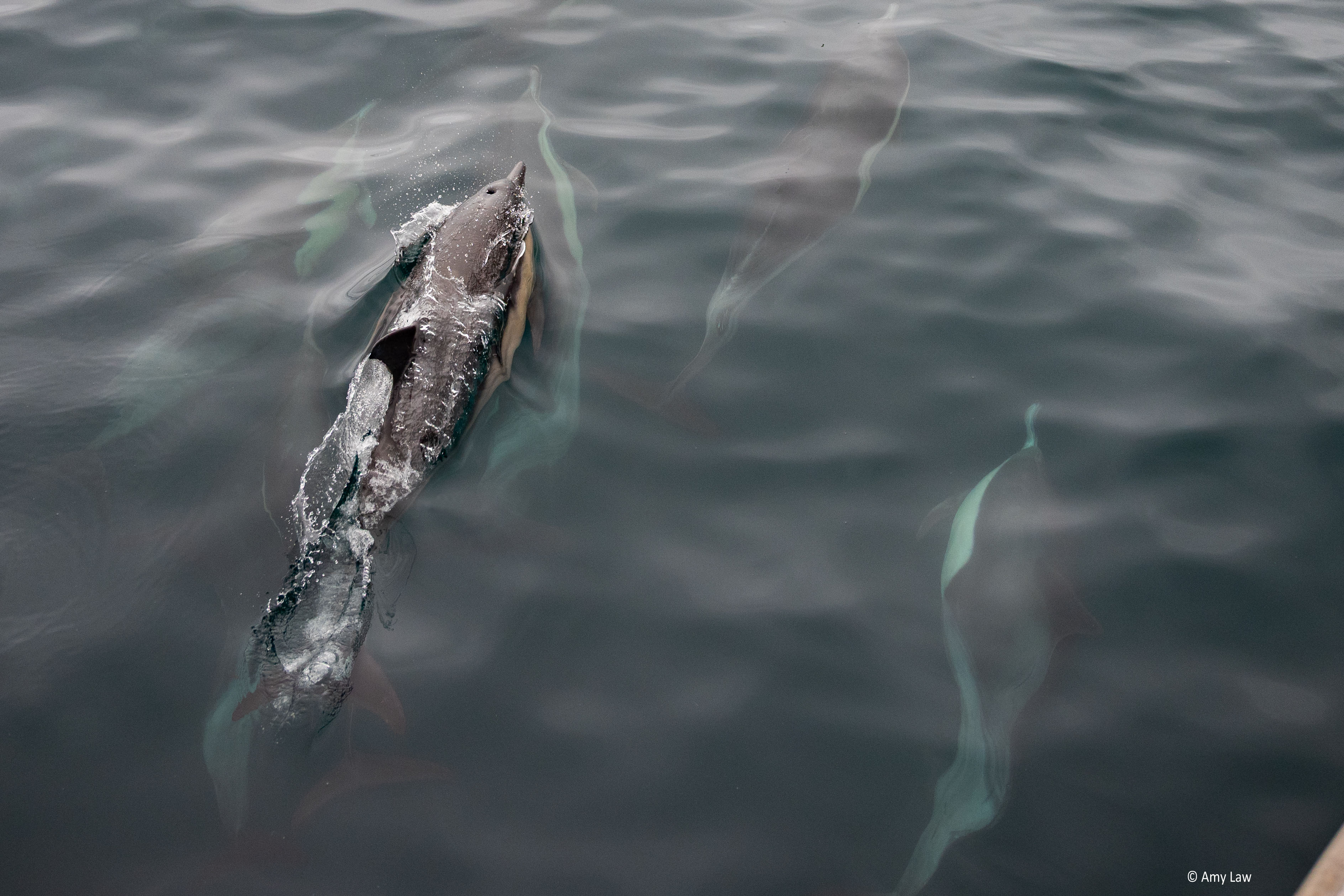
It was only when we looked down at all the dolphins below the surface that we really realized just how many were in the water around us. In this photo, one is breaking the surface. But there are six below the surface of the water. If you counted every dolphin on the surface at any one time, then multiplied it by six below the surface, a thousand dolphins seemed like a reasonable guess. And outrageous fun!

About this time, the humpback whales arrived.

The whales were a little careless in where they surfaced. The whale below came up right next to the boat.

Rather than chasing the anchovies on the surface, the whales dive deeper. On this day, they stayed down around six minutes per dive.

The skipper said that the whales flip their tails in the air so that they can line themselves up to go straight down — all of their mass is positioned directly above their heads, helping them dive. This makes the dive more efficient, burning less energy that they will need when they migrate to calving grounds in Hawaii or the Gulf of California.


Leave a Reply